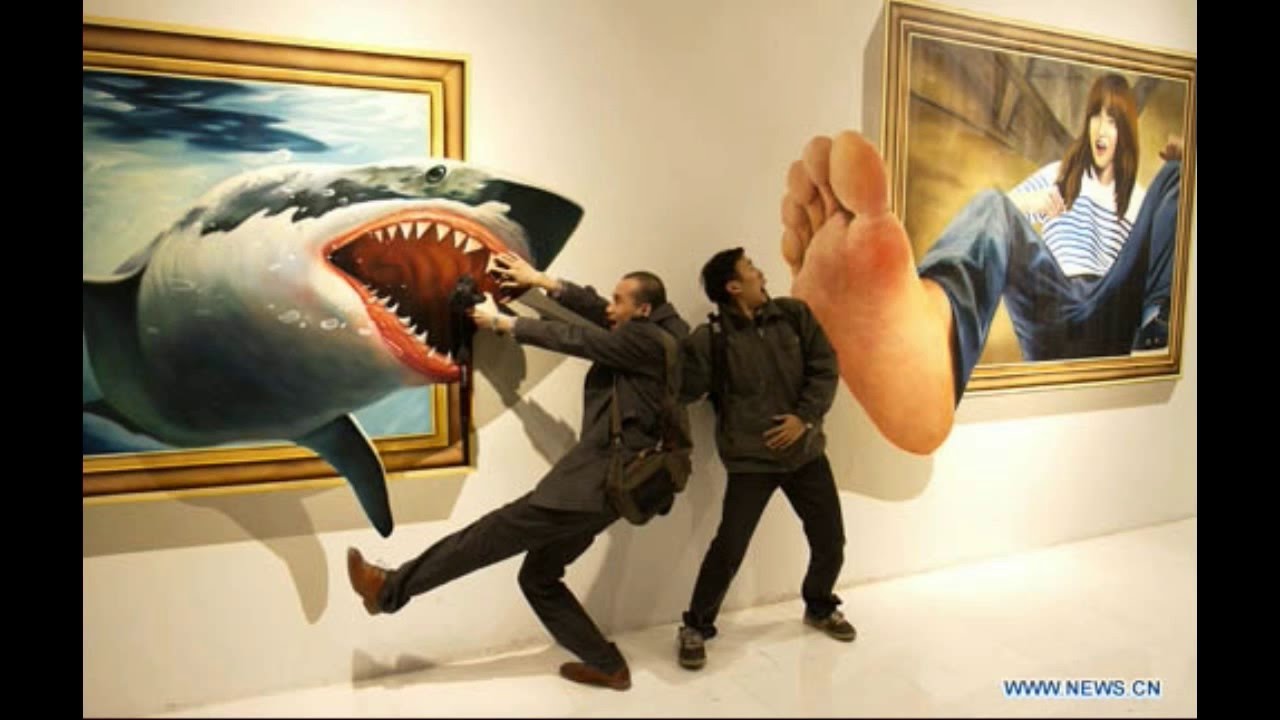
Trompe-l’œil is an art technique that uses realistic images to create the illusion that the depicted objects exist in three dimensions. The goal is to fool the eye into thinking a painting or a image it’s something real but in the same time surreal
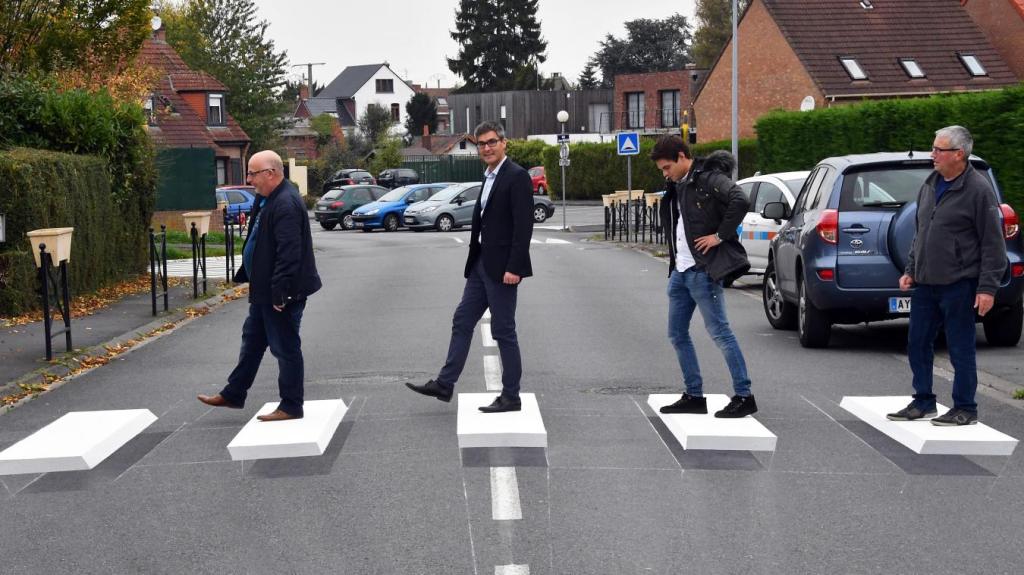
“The phrase, which can also be spelled without the hyphen and ligature in English as trompe l’oeil,[1] originates with the artist Louis-Léopold Boilly, who used it as the title of a painting he exhibited in the Paris Salon of 1800.[2] Although the term gained currency only in the early 19th century, the illusionistic technique associated with trompe-l’œil dates much further back.[3] It was (and is) often employed in murals. Instances from Greek and Roman times are known, for instance in Pompeii. A typical trompe-l’œil mural might depict a window, door, or hallway, intended to suggest a larger room.
A version of an oft-told ancient Greek story concerns a contest between two renowned painters. Zeuxis (born around 464 BC) produced a still life painting so convincing that birds flew down to peck at the painted grapes. A rival, Parrhasius, asked Zeuxis to judge one of his paintings that was behind a pair of tattered curtains in his study. Parrhasius asked Zeuxis to pull back the curtains, but when Zeuxis tried, he could not, as the curtains were included in Parrhasius’s painting—making Parrhasius the winner. “
https://en.wikipedia.org/wiki/Trompe-l%27%C5%93il
The most stunning examples of this technique are seen in street-art. There are many murals around the world meant to fool the eye while looking at them , and they also give the buildings a lot of life !

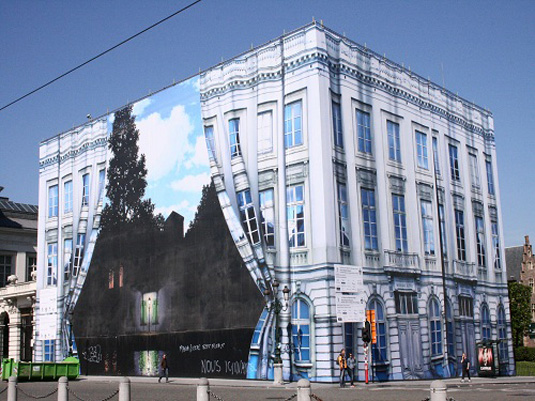
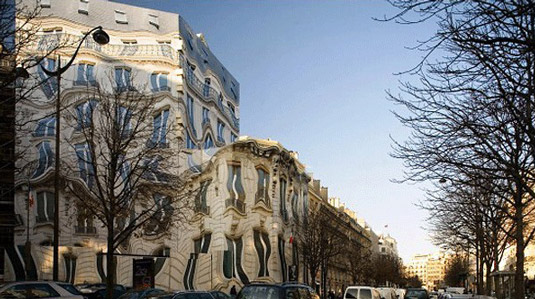
Some time ago Mehmet Iksel was working on huge wallpaintings for deisgners around the world. Even tho everything went well with his business , he was dreaming at doing this technique digitally.He moved to London with his wife to make this dream come true. The walls of their flat, were papered with their designs . Though it is now possible to print on almost any surface or material, scanning was his ingenious innovation . Traditionally, a trompe l’oeil was a hand-painted scene on a wall that gave an illusion of depth, typically a window to a distant world. This was, and is, a type of art asking for high skills. So for centuries it remained the preserve of the rich. High-resolution scanning and digital photography are expanding the possibilities of trompe l’oeils, and their reach. Narrative scenes remain popular, but the 21st-century take on the trompe l’oeil is essentially tongue-in-cheek: the illusion of texture, the imitation of materials such as hanging fabric or plaster moulding, or abstract designs with three-dimensional depth, for instance.
https://www.ft.com/content/c632c2f8-e1fa-11e5-9217-6ae3733a2cd1
 Darray Tattoos
Leave a comment